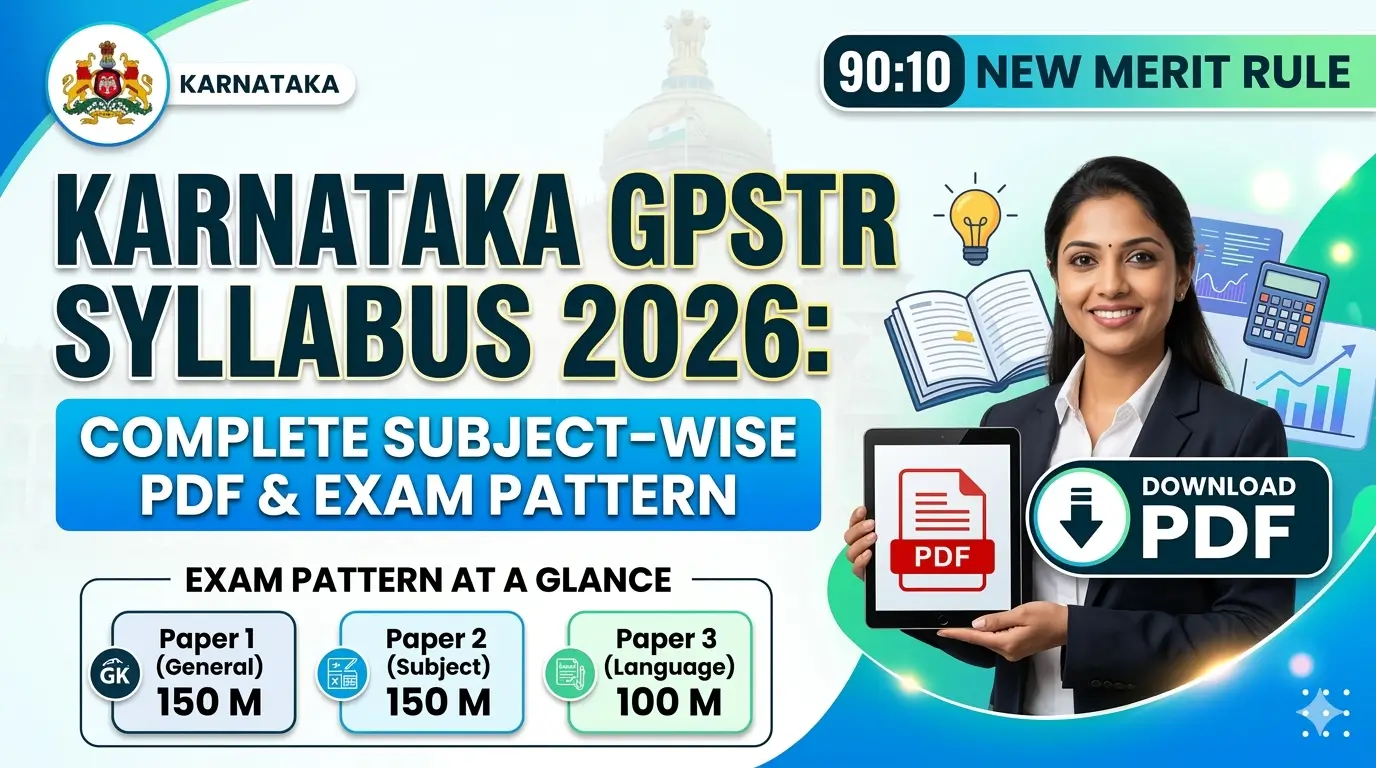
The GPSTR Syllabus 2026 is essential for candidates preparing for the Karnataka Graduate Primary School Teacher Recruitment examination. Understanding the latest exam pattern, subject-wise syllabus, and the detailed structure of Paper 1, Paper 2, and Paper 3 will help candidates prepare effectively for the upcoming exam. The updated syllabus also reflects the new 90:10 merit rule (70% CET, 20% TET, and 10% Academic), making it important for aspirants to review the official GPSTR Syllabus 2026 PDF download and focus on the key topics required to succeed in the recruitment test.
The Karnataka GPSTR Syllabus 2026 for Graduate Primary School Teacher recruitment (Classes 6–8) is structured into three papers with a total of 400 marks. Paper 1 is a 150-mark objective examination covering General Knowledge, General Kannada, General English, Educational Psychology, Health & Value Education, and Computer Literacy. Paper 2 focuses on subject specialization such as Mathematics & Science, Social Studies, or English, consisting of 50 marks MCQs and 100 marks descriptive questions. Paper 3 is a 100-mark descriptive language proficiency test that evaluates writing, comprehension, and grammar in the chosen medium of instruction. The syllabus broadly follows NCERT and Karnataka State Board curricula, primarily based on 6th to 10th standard concepts, with deeper understanding recommended up to the 12th-grade level for competitive exam preparation.
GPSTR Syllabus 2026 Overview & Exam Structure
The GPSTR Syllabus 2026 helps candidates understand the overall structure of the Karnataka Graduate Primary School Teacher Recruitment examination. Before starting preparation, aspirants should review the paper pattern, marks distribution, and subject-wise syllabus for Paper 1, Paper 2, and Paper 3. The recruitment process also follows the updated 90:10 merit rule, where 70% weightage is given to CET scores, 20% to TET marks, and 10% to academic performance. Understanding the exam overview and syllabus structure will help candidates plan an effective preparation strategy.
Karnataka 1st PUC Results 2026: Results declared on 31 March. Check result link, marks memo download, and latest updates online here.
👉 Check Result NowKarnataka 2nd PUC Result 2026 (Exam 1): Check your result online at karresults.nic.in. Enter your registration number to download marks card instantly.
👉 Check Result NowParents looking for free school admission under the RTE quota can check the complete guide on Karnataka RTE Admission 2026-27 – Apply Online, Eligibility, 25% Free Seats & Lottery Result to learn about eligibility criteria, required documents, important dates, and the step-by-step online application process for securing a seat in private schools.
GPSTR Exam Overview (2026 Updated)
| Feature | Details (2026 Updated) |
|---|---|
| Exam Name | Karnataka Graduate Primary School Teacher (GPSTR) |
| Selection Rule | NEW 90:10 Merit System (70% CET + 20% TET + 10% Academic) |
| Total Marks | 400 Marks (Paper 1, Paper 2 & Paper 3 combined) |
| Negative Marking | No negative marking (confirm with official notification) |
| State | Karnataka |
| Official Website | schooleducation.kar.nic.in / sts.karnataka.gov.in |
GPSTR Exam Structure 2026 (Paper-Wise)
The GPSTR exam structure consists of three papers designed to test candidates’ knowledge, subject expertise, and language proficiency.
Paper 1: General Paper (150 Marks)
Exam Format: 150 Multiple Choice Questions (MCQs)
Subjects Included
- General Knowledge & Current Affairs – 25 Marks
- General Kannada – 25 Marks
- General English – 25 Marks
- Educational Psychology & Pedagogy – 50 Marks
- Health & Value Education – 15 Marks
- Computer Literacy – 10 Marks
This paper evaluates candidates’ general awareness, teaching aptitude, and language proficiency.
Paper 2: Subject-Specific Paper (150 Marks)
Exam Format
- 50 MCQs (OMR Based Test)
- 100 Marks Descriptive Written Examination
Subject Options
- Mathematics & Science
- Biological Science
- Social Studies
- English Language
Candidates must select their subject specialization according to their educational background.
Paper 3: Language Proficiency Paper (100 Marks)
Exam Format: Descriptive Written Examination
Purpose
This paper evaluates candidates’ language proficiency and communication skills in the medium of instruction.
Language Options
- Kannada
- English
- Urdu
- Other languages (as specified in the official notification)
📚 Candidates preparing for Karnataka Teacher Jobs 2026 should also check the latest update on GPSTR Recruitment 2026 Karnataka – Notification, Eligibility & Apply Online . This guide explains vacancy details, educational qualification, age limit, exam pattern, and the application process for upcoming government school teacher recruitment in Karnataka.
Aspirants preparing for Karnataka teacher recruitment should carefully read our detailed guide on Karnataka HSTR Recruitment 2026: Official Notification & New 90:10 Rule Details , which explains eligibility criteria, selection process, important dates, and the impact of the newly introduced 90:10 rule in simple terms. This guide helps candidates understand the changes clearly and prepare effectively for the recruitment process.
GPSTR Paper-Wise Marks Distribution
| GPSTR 2026 Paper | Subject Area & Exam Type | Total Marks |
|---|---|---|
| Paper 1 | General Paper (GK, Psychology, Languages, Computer) – MCQ | 150 |
| Paper 2 | Subject-Specific (Maths, Science, or Social) – MCQ + Descriptive | 150 |
| Paper 3 | Language Proficiency (Teaching Medium) – Descriptive | 100 |
| TOTAL | Final Exam Aggregate Score | 400 Marks |
| Merit Rule | New 90:10 Ratio (90% CET/TET weightage for 2026 selection) | — |
GPSTR Exam Overview 2026 (Selection Process & Merit Rule)
The GPSTR Exam Overview 2026 helps candidates understand the complete recruitment process for the Karnataka Graduate Primary School Teacher examination. Before starting preparation according to the GPSTR Syllabus 2026, aspirants should clearly understand the selection process, exam structure, and the updated merit calculation rule used to prepare the final selection list.
The GPSTR recruitment process follows the new 90:10 merit rule, which determines the final ranking of candidates based on multiple performance factors. According to this rule, 70% weightage is given to the CET examination score, 20% weightage to the TET score, and 10% weightage to academic performance. This evaluation system ensures that candidates are selected based on both their exam performance and educational qualifications.
Understanding the GPSTR exam overview and selection process will help candidates focus on important areas such as CET preparation, TET qualification, and academic scoring while planning their preparation strategy.
GPSTR Selection Process & Merit Rule
| Feature | Official 2026 Updated Details |
|---|---|
| Exam Name | Graduate Primary School Teacher Recruitment (GPSTR) |
| Conducting Authority | Karnataka School Education Department |
| Selection Process | CET Written Examination + Merit Calculation |
| Merit Rule | NEW 90:10 Weightage System |
| CET Score Weightage | 70% (Competitive Exam Performance) |
| TET Score Weightage | 20% (KARTET / CTET Paper-II) |
| Academic Weightage | 10% (Degree + B.Ed/D.El.Ed Marks) |
| Total Exam Marks | 400 Marks (Paper 1, 2, & 3 Combined) |
| State | Karnataka |
GPSTR Exam Structure 2026 (Paper-Wise Pattern)
The GPSTR Exam Structure 2026 explains how the written examination is divided according to the GPSTR Syllabus 2026. The Karnataka Graduate Primary School Teacher Recruitment examination is conducted in three papers, designed to evaluate candidates’ general awareness, subject knowledge, and language proficiency. The combined written examination carries a total of 400 marks, and understanding the paper-wise pattern helps candidates plan their preparation effectively.
Each paper focuses on a different area of assessment, ensuring that candidates demonstrate both academic knowledge and teaching aptitude required for the role of a Graduate Primary School Teacher in Karnataka.
GPSTR Paper-Wise Marks Distribution
| Paper | Subject Area & Exam Type | Marks |
|---|---|---|
| Paper 1 | General Paper (GK, Psychology, Languages, Computer) – Objective | 150 Marks |
| Paper 2 | Subject-Specific (Maths, Science, or Social Studies) – MCQ + Descriptive | 150 Marks |
| Paper 3 | Language Proficiency (Teaching Medium) – Descriptive | 100 Marks |
| TOTAL | Final Aggregate Marks for Merit Selection | 400 Marks |
Paper 1: General Paper (150 Marks)
Exam Format: 150 Multiple Choice Questions (MCQs)
Subjects Covered
- General Knowledge & Current Affairs – 25 Marks
- General Kannada – 25 Marks
- General English – 25 Marks
- Educational Psychology & Pedagogy – 50 Marks
- Health & Value Education – 15 Marks
- Computer Literacy – 10 Marks
This paper evaluates candidates’ general awareness, language skills, and teaching aptitude.
Paper 2: Subject-Specific Paper (150 Marks)
Exam Format
- 50 MCQs (OMR-based test)
- 100 Marks Descriptive Written Examination
Subject Options
- Mathematics & Science
- Biological Science
- Social Studies
- English Language
Candidates must select their subject specialization based on their educational background.
Paper 3: Language Proficiency Paper (100 Marks)
Exam Format: Descriptive Written Examination
Purpose
This paper evaluates candidates’ language proficiency and communication ability in the medium of instruction used in schools.
Language Options
- Kannada
- English
- Urdu
- Other languages (as specified in the official notification)
GPSTR Syllabus 2026 (Subject-Wise Topics)
The GPSTR Syllabus 2026 provides a detailed outline of the subjects and important topics included in the Karnataka Graduate Primary School Teacher Recruitment examination. Candidates preparing for the exam should carefully review the subject-wise syllabus for Paper 1, Paper 2, and Paper 3, as each paper evaluates different skills such as general knowledge, teaching methodology, subject expertise, and language proficiency.
Understanding the GPSTR Syllabus 2026 subject-wise topics will help candidates organize their preparation strategy and focus on the most relevant areas according to the latest exam pattern and marks distribution.
GPSTR Paper 1 Syllabus (General Paper)
The GPSTR Paper 1 Syllabus focuses on evaluating candidates’ general awareness, language skills, and teaching aptitude required for the Karnataka Graduate Primary School Teacher Recruitment examination. According to the GPSTR Syllabus 2026, this paper carries 150 marks and consists of multiple-choice questions (MCQs) covering several important subjects related to general studies and education.
Candidates preparing for Paper 1 should concentrate on understanding the core concepts of general knowledge, educational psychology, pedagogy, and language proficiency, as these topics play a significant role in assessing teaching capability and overall awareness.
Subjects and Marks Distribution
| GPSTR Paper 1 Subject | Marks Distribution (2026) |
|---|---|
| General Knowledge & Current Affairs | 25 Marks |
| General Kannada Language | 25 Marks |
| General English Language | 25 Marks |
| Educational Psychology & Pedagogy | 50 Marks |
| Health & Value Education | 15 Marks |
| Computer Literacy (Awareness) | 10 Marks |
| Total Marks for Paper 1 | 150 Marks |
Important Topics to Prepare
General Knowledge & Current Affairs
- National and International Current Affairs
- Indian History and Geography
- Indian Constitution and Polity
- Karnataka State History and Culture
- Important Government Schemes
General Kannada
- Kannada Grammar
- Vocabulary and Usage
- Reading Comprehension
- Sentence Formation
General English
- Basic Grammar and Tenses
- Vocabulary and Synonyms
- Comprehension Passages
- Sentence Correction
Educational Psychology & Pedagogy
- Child Development and Learning Theories
- Teaching Methods and Classroom Management
- Educational Psychology Concepts
- Learning Evaluation Techniques
Health & Value Education
- Basic Health Awareness
- Moral and Value Education
- School Health Programs
Computer Literacy
- Basic Computer Fundamentals
- MS Office Basics
- Internet and Digital Literacy
GPSTR Paper 2 Syllabus (Subject-Specific Paper)
The GPSTR Paper 2 Syllabus evaluates candidates’ subject expertise and teaching methodology based on their chosen specialization. According to the GPSTR Syllabus 2026, this paper carries 150 marks and consists of both objective and descriptive questions. The paper is designed to test a candidate’s understanding of core subject concepts, analytical ability, and application of knowledge in classroom teaching.
Candidates appearing for the GPSTR examination must select a subject based on their academic qualification and specialization. Proper preparation of subject-specific topics is essential to perform well in this paper.
GPSTR Paper 2 Exam Pattern
| Section | Type of Questions (2026 Pattern) | Marks |
|---|---|---|
| Objective Section | 50 MCQs (OMR Based Test) – Pure Subject Knowledge | 50 Marks |
| Descriptive Section | Subject-Based Written Answers (2, 3, & 5 Mark Questions) | 100 Marks |
| Total Score | UPDATED Overall Paper 2 Weightage | 150 Marks |
| Selection Rule | 70% CET Weightage (Now carries higher importance for ranking) | — |
Subject Options in GPSTR Paper 2
Candidates can choose one of the following subjects according to their academic background:
- Mathematics & Science
- Biological Science
- Social Studies
- English Language
Each subject focuses on core concepts, subject methodology, and practical teaching applications.
Important Areas to Prepare
Mathematics & Science
- Algebra and Geometry Concepts
- Physics and Chemistry Fundamentals
- Problem Solving Techniques
- Teaching Methodology for Mathematics and Science
Biological Science
- Botany and Zoology Concepts
- Environmental Science
- Human Biology
- Teaching Methods in Biological Science
Social Studies
- History and Cultural Heritage
- Geography and Environmental Studies
- Civics and Political Science
- Social Science Teaching Methodology
English Language
- English Grammar and Usage
- Literature and Reading Comprehension
- Writing Skills and Communication
- Teaching Methods for English Language
GPSTR Paper 3 Syllabus (Language Proficiency)
The GPSTR Paper 3 Syllabus focuses on evaluating candidates’ language proficiency, writing ability, and communication skills required for effective classroom teaching. According to the GPSTR Syllabus 2026, this paper carries 100 marks and is conducted in a descriptive format. The purpose of this paper is to assess a candidate’s ability to express ideas clearly in the medium of instruction used in schools.
Candidates appearing for this paper must demonstrate strong skills in writing, comprehension, grammar, and language usage, which are essential for teaching and interacting with students in the classroom environment.
GPSTR Paper 3 Exam Pattern
| Section | Type of Questions (Paper 3) | Marks |
|---|---|---|
| Descriptive Writing | Essay Writing / Paragraph Writing (Teaching Medium) | 40 Marks |
| Comprehension | Reading Passages & Interpretation Skills | 30 Marks |
| Grammar & Usage | Language Skills, Vocabulary, and Syntax | 30 Marks |
| TOTAL SCORE | Paper 3 Aggregate Marks | 100 Marks |
| Status | MANDATORY Qualifying Nature (Must secure minimum passing marks) | — |
Important Topics to Prepare
Essay Writing
- Educational Topics
- Social Issues
- Current Affairs Related Essays
Reading Comprehension
- Passage Reading
- Interpretation of Ideas
- Understanding Context
Grammar and Language Usage
- Sentence Structure
- Vocabulary and Word Usage
- Basic Grammar Rules
Communication Skills
- Written Expression
- Language Clarity
- Logical Presentation of Ideas
Language Options
Candidates must write Paper 3 in the language chosen as the medium of instruction, which may include:
- Kannada
- English
- Urdu
- Other languages as specified in the official notification
GPSTR Exam Pattern 2026
The GPSTR Exam Pattern 2026 explains the complete structure of the Karnataka Graduate Primary School Teacher Recruitment examination. Candidates preparing according to the GPSTR Syllabus 2026 should understand the exam pattern to know the number of papers, question format, and marks distribution used in the examination.
The GPSTR written exam consists of three papers, designed to evaluate candidates’ general knowledge, subject expertise, and language proficiency. The combined written examination carries a total of 400 marks, and understanding the exam pattern helps candidates prepare effectively and manage time during the exam.
GPSTR Exam Pattern Overview
The GPSTR Exam Pattern Overview helps candidates understand the basic structure of the Karnataka Graduate Primary School Teacher Recruitment examination. According to the GPSTR Syllabus 2026, the written test is divided into three papers, and each paper evaluates different skills such as general knowledge, subject expertise, and language proficiency.
The total marks for the GPSTR written examination are 400 marks, and candidates must perform well in all papers to secure a good score. Understanding the exam pattern allows aspirants to plan their preparation strategy effectively and focus on the most important sections of the syllabus.
GPSTR Exam Pattern at a Glance
| Paper Number | Question Format & Type | Total Marks |
|---|---|---|
| Paper 1 | Objective (Multiple Choice Questions – OMR Based) | 150 Marks |
| Paper 2 | Objective + Descriptive (Mixed Format Written Test) | 150 Marks |
| Paper 3 | Descriptive Written Examination (Language Test) | 100 Marks |
| TOTAL MARKS | UPDATED Combined Merit Aggregate | 400 Marks |
| Selection Rule | New 90:10 Merit System (70% CET + 20% TET + 10% Academics) | — |
Key Highlights of GPSTR Exam Pattern
- The examination consists of three papers.
- Paper 1 contains objective questions related to general knowledge, language skills, and teaching aptitude.
- Paper 2 includes both objective and descriptive questions based on the candidate’s chosen subject specialization.
- Paper 3 evaluates language proficiency and writing skills through descriptive questions.
- The total marks for the written examination are 400 marks.
Understanding the GPSTR exam pattern overview will help candidates prepare according to the paper structure and allocate study time efficiently.
GPSTR Paper-Wise Exam Pattern
The GPSTR Paper-Wise Exam Pattern explains how the Karnataka Graduate Primary School Teacher Recruitment examination is divided into different papers according to the GPSTR Syllabus 2026. The written examination consists of three papers, and each paper evaluates different competencies such as general knowledge, subject expertise, and language proficiency.
Understanding the paper-wise exam pattern helps candidates know the number of questions, marks distribution, and type of questions asked in the exam. This allows aspirants to prepare strategically and focus on important areas of the syllabus.
GPSTR Paper-Wise Marks Distribution
| Paper | Question Type & Format | Total Marks |
|---|---|---|
| Paper 1 | Multiple Choice Questions (MCQs) – OMR Based | 150 Marks |
| Paper 2 | MCQ + Descriptive Questions (Subject Knowledge) | 150 Marks |
| Paper 3 | Descriptive Written Examination (Language Test) | 100 Marks |
| TOTAL SCORE | UPDATED Combined Merit Aggregate | 400 Marks |
Paper 1 – General Paper
- Question Type: Objective (MCQs)
- Total Marks: 150
Subjects Covered:
- General Knowledge & Current Affairs
- General Kannada
- General English
- Educational Psychology & Pedagogy
- Health & Value Education
- Computer Literacy
This paper tests candidates’ general awareness and teaching aptitude.
Paper 2 – Subject-Specific Paper
Question Format:
- 50 MCQs – 50 Marks
- Descriptive Written Section – 100 Marks
Total Marks: 150
Candidates must answer questions based on their chosen subject specialization, such as Mathematics & Science, Biological Science, Social Studies, or English.
Paper 3 – Language Proficiency Paper
- Question Type: Descriptive Written Examination
- Total Marks: 100
This paper evaluates candidates’ language proficiency, writing ability, and communication skills required for teaching in schools.
GPSTR Syllabus 2026 PDF Download
The GPSTR Syllabus 2026 PDF contains the complete official syllabus for the Karnataka Graduate Primary School Teacher Recruitment examination. Candidates preparing for the exam should download the official syllabus document to understand the subject-wise topics, exam pattern, and marks distribution for Paper 1, Paper 2, and Paper 3.
Reviewing the syllabus PDF helps aspirants prepare according to the latest exam pattern and recruitment guidelines, ensuring they focus on important topics included in the GPSTR examination. Candidates are advised to download and carefully review the syllabus before starting their preparation.
The following are the official GPSTR syllabus PDF links released by the Karnataka School Education Department. These documents were used for the previous GPSTR recruitment (2022) and are expected to serve as the base syllabus for the upcoming GPSTR 2026 examination.
Official GPSTR Syllabus PDF Links
GPSTR Paper-I Syllabus (General Paper)
https://schooleducation.karnataka.gov.in/uploads/media_to_upload1692352785.pdf
GPSTR Paper-II English Syllabus
https://schooleducation.karnataka.gov.in/uploads/media_to_upload1692352847.pdf
GPSTR Paper-II Social Studies Syllabus
https://schooleducation.karnataka.gov.in/uploads/media_to_upload1692352860.pdf
GPSTR Paper-II Maths & Science Syllabus
https://schooleducation.karnataka.gov.in/uploads/media_to_upload1692352873.pdf
GPSTR Paper-III Language Paper Syllabus
https://schooleducation.karnataka.gov.in/uploads/media_to_upload1692352889.pdf
These documents include the complete GPSTR syllabus, subject-wise topics, and exam structure for Paper 1, Paper 2, and Paper 3.
GPSTR Syllabus 2026 Official PDF Download Link
Candidates can download the official GPSTR Syllabus 2026 PDF from the official website of the Karnataka School Education Department. The syllabus PDF includes detailed information about the exam pattern, subject-wise syllabus, and paper structure.
| Document Name | Action |
|---|---|
| GPSTR Syllabus 2026 PDF OFFICIAL | 💾 Download Here |
| GPSTR Recruitment Notification LATEST | 📄 Download Here |
| GPSTR Old Question Papers | 🔍 View Files |
Downloading the official syllabus document helps candidates verify the latest topics, exam structure, and instructions provided by the recruitment authority.
How to Download GPSTR Syllabus 2026 PDF
Follow these steps to download the official syllabus:
- Visit the official website of the Karnataka School Education Department.
- Navigate to the Recruitment or Notification section.
- Search for the GPSTR Recruitment Notification or Syllabus link.
- Click on the GPSTR Syllabus 2026 PDF download link.
- Save the document and review the syllabus for exam preparation.
Candidates should always download the syllabus from the official portal to ensure they are using the latest version of the syllabus.
GPSTR 90:10 Merit Rule Explained
The GPSTR 90:10 merit rule is an important part of the Karnataka Graduate Primary School Teacher recruitment process. According to the latest recruitment policy, the final merit list is prepared using a combined evaluation system that considers CET scores, TET marks, and academic performance. Understanding this rule helps candidates know how their final selection score is calculated.
Under this system, candidates must perform well in both the Common Entrance Test (CET) and the Teacher Eligibility Test (TET) while also maintaining good academic performance, as all three components contribute to the final merit ranking.
GPSTR Merit Calculation Formula
The final merit score is calculated based on the 90:10 weightage system, which distributes marks across different components of the recruitment process.
| Selection Component | Weightage (2026 Rule) |
|---|---|
| CET Examination Score | 70% MAJOR WEIGHT |
| Teacher Eligibility Test (TET) Score | 20% (KARTET or CTET) |
| Academic Performance | 10% (Degree & B.Ed/D.El.Ed Marks) |
| TOTAL SELECTION WEIGHTAGE | 100% |
This evaluation system ensures that candidates are selected based on both exam performance and educational qualifications.
Importance of the GPSTR 90:10 Merit Rule
- Provides a balanced evaluation system for teacher recruitment.
- Encourages candidates to perform well in CET and TET exams.
- Considers academic achievements along with exam scores.
- Helps create a transparent and fair merit list for GPSTR recruitment.
Understanding the GPSTR 90:10 merit rule allows candidates to plan their preparation strategy and focus on improving their CET performance, TET qualification, and academic records.
GPSTR Marking Scheme 2026
The GPSTR Marking Scheme 2026 explains how marks are distributed across different papers in the Karnataka Graduate Primary School Teacher Recruitment examination. Understanding the marking scheme helps candidates know how many marks each paper carries, how answers are evaluated, and how the final score is calculated.
According to the GPSTR exam pattern, the written examination consists of three papers with a combined total of 400 marks. Each paper evaluates different skills such as general knowledge, subject expertise, and language proficiency. Candidates must perform well in all sections to achieve a good overall score in the examination.
GPSTR Paper-Wise Marks Distribution
The GPSTR written examination is divided into three papers with the following marks distribution:
| GPSTR Paper | Subject Area & Format | Total Marks |
|---|---|---|
| Paper 1 | General Paper (GK, Psychology, Languages, Computer) – MCQ | 150 Marks |
| Paper 2 | Subject-Specific (Maths, Science, or Social) – MCQ + Descriptive | 150 Marks |
| Paper 3 | Language Proficiency (Teaching Medium) – Descriptive | 100 Marks |
| TOTAL SCORE | Cumulative Marks for Merit Ranking | 400 Marks |
| Merit Rule | NEW 2026 90:10 Rule (90% CET/TET Weightage) | — |
Understanding the paper-wise marks distribution helps candidates prioritize their preparation based on the weightage of each paper.
Negative Marking in GPSTR Exam
Candidates often wonder whether the GPSTR examination includes negative marking. According to the current exam pattern, there is generally no negative marking for incorrect answers, especially in the objective sections of the exam. However, candidates should always verify this information in the official recruitment notification, as the marking policy may change depending on the exam authority’s guidelines.
How GPSTR Marks Are Calculated
The final merit score for GPSTR recruitment is not based only on the written examination. The recruitment process follows the 90:10 merit rule, which combines different performance factors.
| Selection Component | Weightage (90:10 Rule) |
|---|---|
| CET Examination Score | 70% MAJOR WEIGHT |
| Teacher Eligibility Test (TET) | 20% (KARTET / CTET) |
| Academic Performance | 10% (Degree & Professional Marks) |
| TOTAL SELECTION WEIGHTAGE | 100% |
This system ensures that candidates are evaluated based on both exam performance and academic qualifications.
GPSTR Previous Year Question Papers
The GPSTR Previous Year Question Papers are one of the most important resources for candidates preparing for the Karnataka Graduate Primary School Teacher Recruitment examination. Practicing previous question papers helps aspirants understand the exam pattern, question difficulty level, and important topics frequently asked in the examination.
By solving previous year papers along with the GPSTR Syllabus 2026, candidates can improve their preparation strategy, identify weak areas, and increase their chances of performing well in the examination.
GPSTR Previous Year Question Papers Overview
Solving GPSTR previous year question papers provides candidates with a clear understanding of the paper structure and marks distribution used in the exam.
Key Benefits
- Understand the actual exam pattern and question format
- Identify important topics frequently asked in the exam
- Improve time management during the examination
- Practice solving objective and descriptive questions
Regular practice of previous papers helps candidates become familiar with the type of questions asked in Paper 1, Paper 2, and Paper 3.
GPSTR Question Papers PDF Download
Candidates can download GPSTR previous year question papers in PDF format to practice offline.
| Subject / Paper | Download PDF Link |
|---|---|
| GPSTR Paper 1: General Studies (GK) | 💾 Download PDF |
| GPSTR Paper 2: Subject (Maths/Science) | 💾 Download PDF |
| GPSTR Paper 2: Subject (Social Studies) | 💾 Download PDF |
| GPSTR Paper 3: Language Proficiency | 💾 Download PDF |
Practicing these papers will help candidates understand the question pattern and exam difficulty level.
How to Use Previous Year Papers for Preparation
Candidates preparing for the GPSTR exam should use previous year papers as part of their study plan.
Preparation Tips
- Solve at least one previous year paper daily during revision.
- Analyze wrong answers and weak areas after completing each paper.
- Practice papers under timed conditions to simulate the real exam.
- Compare answers with the official syllabus and exam pattern.
Using previous year question papers effectively can significantly improve accuracy, speed, and confidence during the actual examination.
GPSTR Preparation Tips 2026
Preparing effectively for the GPSTR exam requires a clear understanding of the GPSTR Syllabus 2026, exam pattern, and marking scheme. Candidates should develop a structured study plan that covers all subjects included in Paper 1, Paper 2, and Paper 3. A combination of consistent revision, solving previous year question papers, and practicing mock tests can significantly improve performance in the examination.
A well-planned preparation strategy will help aspirants manage their time effectively and focus on important topics included in the Karnataka Graduate Primary School Teacher Recruitment examination.
Create a Smart Study Plan for GPSTR
One of the most important preparation strategies is to create a daily study schedule based on the syllabus.
Study Plan Tips
- Divide your preparation time for Paper 1, Paper 2, and Paper 3.
- Allocate more time to subjects with higher marks weightage.
- Set weekly revision targets to review important topics.
- Use reliable books and online resources for concept clarity.
Following a structured study plan helps candidates maintain consistent progress during preparation.
Focus on Important Subjects and Topics
Candidates should identify the most important topics from the GPSTR syllabus and focus on strengthening their understanding of those areas.
Key Preparation Areas
- General Knowledge and Current Affairs
- Educational Psychology and Pedagogy
- Subject-Specific Concepts for Paper 2
- Language Proficiency and Writing Skills
Focusing on high-weightage subjects improves the chances of scoring well in the exam.
Practice Previous Year Question Paper
Solving GPSTR previous year question papers is one of the best ways to understand the exam pattern.
Benefits of Practicing Previous Papers
- Understand the question format and difficulty level
- Identify frequently asked topics
- Improve time management skills
- Build confidence before the exam
Candidates should regularly practice previous papers along with mock tests to evaluate their preparation.
Manage Time Effectively During Preparation
Time management plays a crucial role in preparing for competitive exams like GPSTR.
Effective Time Management Tips
- Set daily study goals for each subject.
- Avoid spending too much time on a single topic.
- Schedule short revision sessions regularly.
- Practice solving questions under exam-like conditions.
Proper time management ensures that candidates cover the entire syllabus before the examination.
Final Thoughts on GPSTR Syllabus 2026
The GPSTR Syllabus 2026 provides a clear roadmap for candidates preparing for the Karnataka Graduate Primary School Teacher Recruitment examination. By understanding the subject-wise syllabus, exam pattern, marking scheme, and paper-wise structure, candidates can plan their preparation more effectively and focus on the most important topics included in the exam.
A successful preparation strategy should include consistent study, regular revision, and solving previous year question papers. Candidates should also practice mock tests and stay updated with the latest notifications to ensure they follow the correct syllabus and exam pattern. Combining a strong understanding of the syllabus with effective time management can significantly improve performance in the GPSTR examination.
In conclusion, candidates who thoroughly review the GPSTR Syllabus 2026, follow a structured study plan, and practice regularly will have a better chance of securing a high score and achieving success in the recruitment process.
GPSTR Syllabus 2026 Frequently Asked Questions (FAQs)
The GPSTR Syllabus 2026 FAQs section answers the most common questions asked by candidates preparing for the Karnataka Graduate Primary School Teacher Recruitment examination. Reviewing these frequently asked questions helps aspirants understand important aspects such as the syllabus structure, exam pattern, marking scheme, and the 90:10 merit rule used in the recruitment process.
Below are some of the most important questions candidates often search for regarding the GPSTR examination.
What is the GPSTR Syllabus 2026?
The GPSTR Syllabus 2026 outlines the subject-wise topics for the Karnataka Graduate Primary School Teacher Recruitment examination. The syllabus is divided into three papers: Paper 1 (General Knowledge & Educational Psychology – 150 marks), Paper 2 (Subject Specialization – 150 marks), and Paper 3 (Language Proficiency – 100 marks). It also aligns with the 90:10 merit rule, where CET, TET, and academic performance determine the final selection.
How many papers are there in the GPSTR exam?
The GPSTR examination consists of three papers conducted as part of the Karnataka Graduate Primary School Teacher Recruitment process. Paper 1 is the General Paper covering subjects like general knowledge, Kannada, English, educational psychology, and computer literacy (150 marks). Paper 2 is the Subject-Specific Paper (150 marks), while Paper 3 evaluates Language Proficiency through descriptive questions (100 marks). The total marks for the GPSTR written examination are 400 marks.
What is the GPSTR 90:10 merit rule?
The GPSTR 90:10 merit rule is used to prepare the final merit list for Karnataka Graduate Primary School Teacher recruitment. Under this system, 70% weightage is given to the CET exam score, 20% to the Teacher Eligibility Test (TET) marks, and 10% to academic performance. This combined evaluation determines the final ranking of candidates.
Is there negative marking in the GPSTR exam?
No, there is generally no negative marking in the GPSTR examination for incorrect answers in the objective sections. Candidates receive marks only for correct responses in the written test. However, applicants should always verify the marking rules mentioned in the official GPSTR recruitment notification, as exam guidelines may change depending on the recruitment authority.
Where can I download the GPSTR Syllabus 2026 PDF?
Candidates can download the GPSTR Syllabus 2026 PDF from the official website of the Karnataka School Education Department at schooleducation.kar.nic.in or sts.karnataka.gov.in. The official syllabus document includes detailed information about the exam pattern, subject-wise topics, and marks distribution for Paper 1, Paper 2, and Paper 3.
What subjects are included in the GPSTR Syllabus 2026?
The GPSTR Syllabus 2026 includes subjects across three papers in the Karnataka Graduate Primary School Teacher examination. Paper 1 covers General Knowledge, General Kannada, General English, Educational Psychology, Health & Value Education, and Computer Literacy. Paper 2 includes subject specialization such as Mathematics & Science, Biological Science, Social Studies, or English. Paper 3 evaluates Language Proficiency, including essay writing, comprehension, and grammar skills.
What is the total marks for the GPSTR exam?
The total marks for the GPSTR examination are 400 marks. The written exam is divided into three papers. Paper 1 (General Paper) carries 150 marks and includes subjects like General Knowledge, Kannada, English, Educational Psychology, Health & Value Education, and Computer Literacy. Paper 2 (Subject-Specific Paper) also carries 150 marks and evaluates the candidate’s chosen subject specialization. Paper 3 (Language Proficiency Paper) carries 100 marks and tests writing ability, grammar, and comprehension skills.
What is the exam pattern for GPSTR 2026?
The GPSTR Exam Pattern 2026 consists of three papers conducted as part of the Karnataka Graduate Primary School Teacher recruitment process. Paper 1 (General Paper) includes objective questions covering General Knowledge, Kannada, English, Educational Psychology, Health & Value Education, and Computer Literacy and carries 150 marks. Paper 2 (Subject-Specific Paper) carries 150 marks and includes 50 MCQs (50 marks) and a descriptive section (100 marks) based on the candidate’s chosen subject. Paper 3 (Language Proficiency) is a descriptive paper of 100 marks that evaluates writing, grammar, and comprehension skills. The total marks for the GPSTR written exam are 400.
Is TET mandatory for GPSTR recruitment?
Yes, Teacher Eligibility Test (TET) qualification is generally required for GPSTR recruitment in Karnataka. According to the latest recruitment policy, candidates must have a valid TET certificate to be eligible for the Karnataka Graduate Primary School Teacher exam. Under the GPSTR 90:10 merit rule, the TET score contributes 20% weightage in the final merit calculation, while the remaining weightage comes from the CET exam and academic performance.
What is the qualification required for GPSTR?
To apply for GPSTR (Graduate Primary School Teacher Recruitment) in Karnataka, candidates must have a Bachelor’s degree in the relevant subject from a recognized university along with a B.Ed. (Bachelor of Education) qualification. In addition, candidates are generally required to have a valid Teacher Eligibility Test (TET) certificate, as it is an important eligibility requirement for teacher recruitment in Karnataka. Applicants must also meet the age limit and other criteria mentioned in the official GPSTR recruitment notification.
How to prepare for GPSTR exam 2026?
To prepare effectively for the GPSTR Exam 2026, candidates should start by thoroughly studying the GPSTR Syllabus 2026 and understanding the exam pattern and marking scheme. Create a structured study plan that covers Paper 1 (General Paper), Paper 2 (Subject-Specific Paper), and Paper 3 (Language Proficiency). Focus on important subjects such as educational psychology, general knowledge, and subject specialization. Regularly practice previous year question papers and mock tests to improve accuracy, speed, and time management.
Are previous year question papers available for GPSTR?
Yes, previous year question papers for the GPSTR exam are available and can be downloaded from various education portals and exam preparation websites. These papers include past exams such as 2017 and 2022 GPSTR question papers for subjects like General Studies, Social Science, Mathematics & Science, and Language papers. Practicing these papers helps candidates understand the exam pattern, question difficulty level, and frequently asked topics.